|
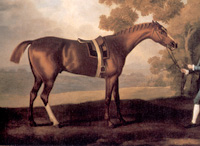
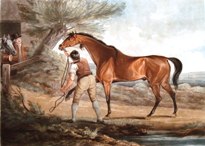
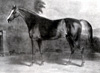
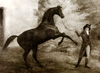
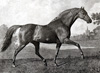
Courtesy of Fores Gallery
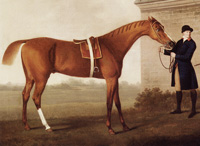
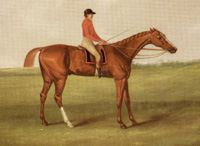
Courtesy of the Stewards
of the Jockey Club, Newmarket

Sire
Line
Eclipse
|
Eclipse ch c 1764 (Shakespeare
or Marske - Spiletta, by
Regulus).
Sire Line Eclipse.
Family
12.
Bred by His Royal Highness William Augustus,
Duke of Cumberland, he was foaled at the Duke's Cranbourne Lodge
stud during the total eclipse of the sun for which he was named. John Lawrence described him as a mature horse: "When I
first saw him he appeared in high health, of a robust constitution. His
shoulder was very thick, but extensive and well placed; his
hind-quarters appeared higher than his fore-hand; and it was said that
no horse in his gallop ever threw his haunches with greater effect, his
agility and his stride being on a par. He stood over a great deal of
ground, and in that respect was the opposite of
Flying
Childers - a short-backed, compact horse, whose reach lay in his
lower limbs." He is thought to have stood around 15.2 hands.
After the Duke's
death, in October of 1765, his stable was dispersed at auction by Mr
Richard Tattersall. Eclipse was purchased by William Wildman for 75
guineas. In 1769 Dennis O'Kelly purchased a half-interest in him for 650
guineas and later bought the remainder for 1,100 guineas.
An unruly colt, he
was said to have been sent to a rough-rider who was also a notorious
poacher by night. While there may have been little truth in the story,
it indicates his obstreperous nature. In his first start he distanced
all four of his opponents while under massive restraint by his jockey. O'Kelly won a great
deal of money from betting on Eclipse, and it is said that the famous
phrase "Eclipse first, the rest nowhere" originated on this
day. Reporting varies, however, he won all of his starts including
numerous King's Plates with ease, apparently never having been extended.
His race against Bucephalus (ch c 1764 Regulus)
was said to be the most difficult for Eclipse and although "the north
country horse ... ran like a good and true son of Regulus" he afterwards
never "regained his form, so severe and heartbreaking were the efforts
he made". Sportsmen agreed that Eclipse was the best horse seen on the
turf since Flying Childers.
Sir Theodore Cook
wrote of him: "His excellence was not only owing to the races he
won, but even more clearly to the astonishing ease with which he won
them, and to the fact that in addition to his undoubted speed and
stride, he possessed sound wind, an ability to carry heavy weight, and
an endurance over long distances which could never be thoroughly tested,
for its limit was never reached."
In 1771 he retired to
stud at Clay Hill, near Epsom, Surrey, where he stayed until 1788, when
he was moved, in a carriage pulled by a pair, to O'Kelly's Cannons Park
stud in Stanmore, Middlesex. His fee was 50 guineas the first year, and
later varied between 25 and 30 guineas.
A great great
grandson of the Darley Arabian, he was
an overwhelming success in the stud, becoming the progenitor of the
Eclipse
sire line and thus the tail-male ancestor of nearly every living
thoroughbred. The line continued mainly through two sons,
Pot8os
and King Fergus.
The excellent
racehorse and sire Pot8os (ch c 1773) numbered
among his get the Derby winner and Champion Sire
Waxy
(b c 1795), the Derby and St Leger winner Champion (b c 1797), the
Derby winner Tyrant (b c 1799) and the Oaks winner Nightshade (b f
1785).
The Champion Sire
King Fergus (ch c 1775), himself a winner of eight races, got three St
Leger winners, Beningbrough (b c 1791),
Hambletonian (b c 1792) and
Young Traveller (ch c 1788).
The classic winning
offspring of Eclipse include the Derby winners
Saltram
(br c 1780), Young Eclipse (b c 1778) and Serjeant (b c 1781), and
the Oaks winner Annette (b f 1784). His son Volunteer
(ch c 1780) sired the Derby winner Spread Eagle (b c 1792).
Other sons of Eclipse
exerted varying degrees of influence. Among them were Don Quixote (ch c
1784), Dungannon (b c 1780), Joe Andrews
(b c 1778), Jupiter (ch c 1774), Meteor
(ch c 1783), Orlando (b c 1778), and Satellite
(ch c 1774).
Oddly enough Eclipse
was never a Champion Sire himself, although he was second eleven times
between 1778 and 1788. He died of colic at Cannons in 1789.
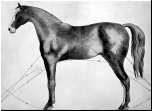 |
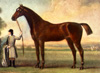
Professor to the
Veterinary College of London, Monsieur Charles Vial de St Bel, performed an
autopsy on Eclipse. His measurements determined that the horse stood
16.2 hands. While without artistic pretensions, his detailed drawings
reveal significantly different markings from those generally seen in
other portraits. |
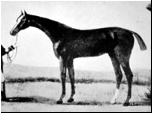 |
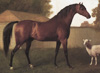
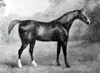
This portrait by Francis Sartorius displays a
smaller face marking, and the off-hind sock ends
half-way up the cannon bone. In contrast, St Bel's sketch shows a
white nose and an off-hind stocking extending above the hock. |
| Eclipse |
Marske |
Squirt |
Bartlet's
Childers |
| Sister to
Old Country Wench |
| Ruby Mare |
Hutton's Blacklegs |
| Bay
Bolton Mare |
| Spilletta |
Regulus |
Godolphin Arabian |
| Grey
Robinson |
| Mother
Western |
Easby
Snake |
| Old
Montagu Mare |
|
| Race Record |
In 1769 he won a £50 Plate at Epsom,
beating Mr Fortescue's
Gower (b c 1764 Gower Stallion), Mr Castle's Chance
(b c 1763 Gower's Sweepstakes), Mr Jenning's Trial
(ch c 1764 Blank) and Mr
Quick's Plume (br c 1763 Feather).
Won a £50
Plate at Ascot, beating Mr Fettyplace's
Cream de Barbade (b c 1764 Snap), winning both heats "very easily".
Won the 100gs King's Plate at Winchester, beating
Mr Turner's Slouch (b c Othello), the Duke of Grafton's Chigger (gr
c 1763 Slouch), Mr Gott's Juba (b c 1764
Regulus), Mr O'Kelly's
Caliban (br c Brilliant)
and Mr Bailey's Clanvil (b c Bajazet) with the latter two being distanced in
the first heat.
Walked over for a £50 Plate at the same meeting.
Won the City Plate at Salisbury, beating Mr Fettyplace's Sulphur (gr c 1762
Spectator).
Walked over for the King's Plate at the same
meeting.
Walked over for the King's Plate at Canterbury.
Won the King's Plate at Lewes, beating Mr Strode's
Kingston (b c 1763 Sampson).
Won the King's Plate at Lichfield, beating Mr Freeth's Tardy (b c Matchless). |
In 1770 he
defeated Mr Wentworth's Bucephalus (ch c 1764
Regulus) over the Beacon
Course at Newmarket.
Won the King's Purse at the
same meeting, beating "out of sight" Mr Strode's Pensioner (b c
Blank), Mr Fenwick's Diana
(b f 1763 Regulus) and
Chigger, with Diana and Chigger withdrawn in the 2nd
heat. Pensioner was distanced.
Walked over for the King's Plate at Guildford.
Walked over for the King's Plate at Nottingham.
Walked over for the King's Plate at York.
Won the £319 10s Great Subscription at the same
meeting, beating Mr Wentworth's Tortoise (b c
Snap) and Sir C Bunbury's
Bellario (b c Brilliant),
both said to be "racers of the highest class".
Walked over for the King's Plate at Lincoln.
Won 150gs at Newmarket, beating Sir Charles
Bunbury's Corsican (b c Swiss).
Walked over for the King's Plate at the same place.
Walked over for the King's Plate at Nottingham. This
was his final race. |
| |
|