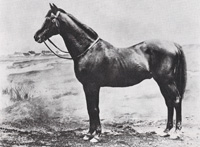
Hermit

Sire Line
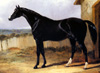
Camel
|
Hermit ch c 1864
(Newminster - Seclusion, by Tadmor). Sire Line Camel.
Family 5-d.
At the June
17th 1865, yearling sale of Mr Blenkiron’s famous Middle Park Stud, the
scene was set for one of the most romantic, yet tragic, episodes in the
annals of the turf.
Edmund Tattersall conducted the sale and in
the opinion of The Times the yearlings were the best offered
since Mr Blenkiron started his annual sales. Two lots stood out: the
colt by Stockwell out of the Oaks winner Governess and the one by
Newminster out of Seclusion.
Rarely had a Stockwell colt been
seen as the first-named. Such was his size that it would have been
possible to have passed him off as a three-year-old. The reputation of
Pedagogue, as he was later to be named, had preceded him, and directly
he appeared in the ring there was a bid of 1,000 guineas. The challenge
was quickly taken up by Henry Chaplin (later Lord Chaplin) who was so
determined to have him that a spirited bid of 1500 guineas quickly
deterred any further bids.
Next but one into the ring was Hermit
– as yet unnamed – a dark chesnut colt by Newminster out of Seclusion,
also secured by Chaplin for 1000 guineas.
Chaplin, youthful
beneficiary of an immense fortune, appeared in a mood to spend it in
pursuit of glory on the Turf, securing three further lots, of which one
was a lovely filly by Newminster out of Triangle (later named Problem)
and another by Marsyas out of Defenceless (later named Boadicea), the
dam of Caractacus.
By a strange coincidence, the very next
yearling to enter the ring, Marksman, by Dundee out of Shot, who was
purchased by Mr James Merry, also for 1000 guineas, was destined to be
instrumental in Hermit’s fame.
It soon became clear that Hermit
was a classy individual; not a big fellow, about 15.2 ½, but with
tremendous hindquarters. And so it was that in the December of his
infancy he was tried over four furlongs up Bury Hill against Problem,
who along with Hermit, Chaplin had purchased at the same Middle Park
sale, and to whom he was conceding thirty-five pounds. He beat her by a
couple of lengths, and the value of this performance was endorsed
two-months later when Problem won the Brocklesby Stakes at Lincoln from
a field of twenty-two runners.
One can imagine the thoughts
passing through the minds of Chaplin, Capt. Machell and the brothers,
George and Charles Bloss, who trained Hermit: this was Hermit – and they
also had Pedagogue!
An element of mystery surrounds Pedagogue.
Some reports – but without any detail – put him 12 lb. in front of
Hermit; others that he ‘was perfectly useless for racing’. Whatever the
true facts, it did not matter: poor Pedagogue was summoned from this
earth in the third year of his life….and Hermit?
| |
| Pedigree |
|
Hermit |
Newminster |
Touchstone |
Camel |
| Banter |
|
Beeswing |
Doctor Syntax |
| Ardrossan Mare |
|
Seclusion |
Tadmor |
Ion |
| Palmyra |
|
Miss Sellon |
Cowl |
| Belle Dame |
|
| Race Record |
| |
Hermit’s first race, as a
two-year-old, in 1866 was a Sweepstakes at the Newmarket First
Spring Meeting – incidentally the race before Lord Lyon was to
win the Two Thousand Guineas, on his way to winning the Triple
Crown. His fellow Middle Park acquaintance, Marksman, was also
in the four-runner field. Hermit beat Marksman, but was himself
beaten by a Newminster filly called Cellina. Just over two weeks
later, he met Cellina again, in a half-mile Biennial at Bath,
and on six pounds worse terms, beat her by a head. In the
Woodcote Stakes at Epsom’s Derby meeting he was beaten three
lengths by a very good filly in Achievement, a full sister to
Lord Lyon, and in the opinion of many contemporary observers,
far superior. She also beat Hermit on the only two other
occasions they met.
He next won a Biennial Stakes at
Ascot, and then two races at Stockbridge, on both occasions
beating Vauban, who won seven of his fifteen races as a
two-year-old.
Vauban was a hardy fellow – but then,
trained at Danebury, he had to be. The Days were not noted for
treating their inmates with kid gloves. They either suffered and
survived – or it was the glue factory.
Hermit was
withdrawn from the Two Thousand Guineas; probably owing to the
Blosses noticing there was something wrong with him. On
investigation it transpired that someone had been giving the
horse a narcotic. Chaplin was informed and he bought in a couple
of detectives; the Blosses redoubled security and Hermit
recovered.
With Hermit absent, Vauban was made favourite
at 5-2 and won by two lengths from Knight of the Garter (owned
by Captain Machell) and Marksman. Knight of the Garter was a
stable companion of Hermit. Confirmation that Captain Machell
and the brothers Bloss, had every justification in believing
they had nothing to fear in the Derby was when in a trial Hermit
gave Knight of the Garter ten pounds over a mile and beat him.
Henry Custance was engaged to ride Hermit, and ten days
before the race went to Newmarket to ride him in a trial over a
mile-and-a-half alongside the Devil’s Dyke up to the Cambridge
Road. The trial horse was the four-year-old, Rama, who the
previous year had shattered the invincibility of Lord Lyon to
the tune of eight lengths in the Doncaster Cup, albeit at an
advantage of eleven pounds.
The weights were arranged at
sixteen pounds in Hermit’s favour. After they had gone a shade
over a mile, Hermit was pulling Custance out of the saddle. Then
suddenly he gave a tremendous cough and almost collapsed in his
stride. Blood streamed from a broken blood vessel in his nose,
smothering Custance in the process. They walked him back across
to the Birdcage, cleaned his nose and mouth and, exercising
discretion, took him the back way home to Bedford Cottage. But
unfortunately Hermit’s mishap had been seen, and the news spread
through Newmarket like the plague.
When Custance
delivered the letter from Captain Machell to Chaplin, explaining
the incident, the blood must have drained from the latter’s
face. Harry, Marquis of Hastings, who three years earlier had
eloped with Chaplin’s fiancée, the desirable Florence Paget,
causing intense rivalry between the two, had been backing
against Chaplin's horse all winter. In fact Florence had written
to a friend that Harry had been laying against Hermit as though
the horse was already dead. Was this related to the poisoning of
Hermit? … something we shall never know.
Chaplin’s
immediate reaction was to scratch his horse, but was persuaded
otherwise – no doubt on account of the large amount of money
Captain Machell had bet on him. In the meantime, Mr Pryor, owner
of The Rake, a much-fancied candidate, who the previous year had
won the Middle Park Plate, beating Achievement by three lengths,
requested Chaplin to release Custance, which Chaplin eventually
agreed to in writing, on the grounds that he did not wish to
deprive Custance of winning the race.
When the news broke
on the Friday before the great race, that The Rake, too, had
broken a blood vessel, it would not have been unreasonable to
infer that the plot was developing in to one of stranger than
fiction. Whether this was a serious situation or not, Mr Pryor
and Joseph Dawson, The Rakes’s trainer, were in no mood to
scratch their horse, and he was duly sent to Epsom for his final
gallop, the day before the race; whereupon, Custance declared
him the worst Derby horse he had ever ridden.
Meantime
George and Charles Bloss appeared to have worked a miracle on
Hermit. After his disappointing trial on The Rake, Custance
caught sight of Hermit doing his final trial. He records that
coming round Tattenham Corner Hermit got the best of the lad on
him, fairly ran away with him, and the ground being as hard as
iron, he bounded over it like a cricket-ball. The trial
convinced Machell that he should run Hermit, and he suggested to
Chaplin that he should reclaim Custance. But having secured his
man, Pryor was in no mind to release him. Chaplin took the
matter to the Stewards, who decided that although his letter had
constituted a release, Mr Pryor should waive his right, as both
horses had broken a blood vessel. But Mr Pryor was unrelenting;
Custance was left on The Rake, who ran exactly as Custance had
expected him to.
The weather on Derby Day was atrocious.
Sleet and snow swept across the downs; the dispirited crowd, in
complete contrast to the general gaiety one would expect at this
event on a normal summer’s day, were sheltering beneath their
umbrellas, huddled together to seek refuge from the biting
winds.
In the ring, bookmakers were being far from
generous; Vauban was at no more than 6-4, with Hermit being laid
at between 66-1 and 100-1. The Palmer, Van Amburgh, The Rake,
and Marksman were the only other runners considered to be a
serious threat to the Danebury favourite.
Few of the
runners appeared to be enjoying the proceedings as they paraded
in the paddock, and poor Hermit, his head hung almost in shame,
was a picture of misery. One observer was heard to comment that
Hermit would not fetch £15 at a fair!
This aside, there
were other problems for Chaplin and Machell, as Hermit was still
without a jockey, and at this late stage it seemed unlikely that
one of experience would be found. At the suggestion of Lord
Coventry, a young Newmarket lad, John Daley, was engaged. He was
only twenty-one, and the son of a trainer, but was far from
being a fashionable jockey. Machell instructed Daley on the
tactics he should pursue, emphasising Hermit had abundant
stamina and good finishing speed, but should be handled
delicately, and if he showed any signs of breaking a blood
vessel, he should be pulled-up. All being well, Machell assured
him that Hermit would give of his best.
The terms on
which Machell engaged Daley were £100 for the ride, £300 if he
was placed and £3000 for a win, and the stakes £7000 (£640,000
at today’s rates) from Chaplin, should he win. Daley could
scarcely believe his good fortune. He had arrived at Epsom
engaged for only one ride, on Baron Rothschild’s filly, Hippia,
in the Oaks. But suddenly he found himself in a position that
could assure him of financial security for life.
The
enforced choice of Daley over Custance may have been a blessing
in disguise. Hermit had shown in his trials his willingness to
respond to a lad, in preference to the more aggressive handling
of Custance. Daley, gentler in approach, although probably a
trifle inhibited by his enormous but potentially rewarding task,
was able to convey to his sensitive steed, a spirit that would
give him a willingness to run for his life.
Snow and
sleet were still whistling across the Downs as the runners
assembled at the start. To compound the discomfort of the crowd
there were ten false starts causing a considerable delay.
Edwards struggled vainly with D’Estournel but the beast refused
to come into line.
At the eleventh attempt they were
away, with the favourite Vauban towing them up the hill towards
the descent to Tattenham Corner, the obstinate D’Estournel
rearing up and flying off in the opposite direction; even
attempting to savage onlookers on the rails.
As the
rainbow coloured field wheeled round Tattenham Corner, through
the gloom it was Danebury’s Vauban who led from Wild Moor,
Marksman and Julius. Hermit was in the middle division behind
The Rake, Van Amburgh, Corporal and The Palmer. As they turned
into the straight Julius and The Rake were beaten. Two furlongs
out the leaders were Marksman, Van Amburgh and Vauban, but a
groan went up from the crowd as Fordham, on the favourite, went
for his whip.
Below the distance Van Amburgh was a spent
force, and as Grimshaw drove Marksman into the lead it looked
odds on him gaining victory. It was here that Daley launched his
attack. There was no need for Hermit to feel the sting of
Daley’s whip or the cut of his spurs. Obeying his instructions
to the letter, his tactful request summoned the required
response from Hermit’s weakened body. He swept past Vauban; he
closed on Marksman, and as the two met the rising ground it
could not be denied that Hermit and Marksman, almost locked
together, fought out the finish with gladiatorial courage.
Daley, probably riding the race of his life, somehow managed to
summon one final effort from Hermit, and in those last few
strides of this sensational race he was in front. The winning
distance – a neck.
Chaplin, overwhelmed, led the
victorious Hermit into the unsaddling enclosure. It was a moment
to treasure: a moment that all Chaplin’s wealth could not have
secured for him. He had just won the best part of £140,000,
(almost 13 million at today’s rates) but it did not compare with
victory in the race itself. In a shade under three minutes
Hermit had achieved immortality and Chaplin would be
inextricably linked with winning the world’s greatest race.
Daley, still not believing his good fortune, slipped the saddle
from Hermit’s back, and Hermit stood there trembling, his body
steaming in the cold May air, his lungs still burning from that
final rush to the line.
Hastings had lost an amount
similar to that which Chaplin had won. But Hermit’s victory was
only contributory to the final tragedy. The defeat the following
year of his peerless filly, Lady Elizabeth, in the Derby and the
Oaks – probably the result of her fifteen races (fourteen of
which she won) as a two-year-old – was the final straw. His
reckless gambling and remarkably extravagant lifestyle
contributed to an untimely end. Suffering from syphilis, he
passed into a coma and died in November of that year – just
twenty-six years old. A short time before his death he told his
oldest friend: "Hermit broke my heart, but I did not show it,
did I." Words that are immortalised as much as Hermit’s victory
itself.
That week was the pinnacle of Daley’s career. On
the Friday he won the Oaks on Hippia, beating the favourite
Achievement. But despite going from obscurity to fame in the
space of forty-eight hours, his anticipated success in the
classics did not materialise, his only other victory being on
the speedy Macgregor, in the 1870 Two Thousand Guineas.
Hermit next won a Biennial Stakes and the St James’s Palace
Stakes at Ascot, beating Julius and The Palmer, both of whom had
finished behind him at Epsom, but was beaten a length by
Achievement in the St Leger. Two days later she beat him again
in the Doncaster Cup; and on the same afternoon he was turned
out again, and won a Sweepstakes over the St Leger course, a
feat that would be unheard of, or even considered, today.
In the autumn of Hermit’s year, Julius, whom some pundits
thought the better horse (which was surprising in view of Hermit
having already beaten him four times) won the Cesarewitch, and a
match was set up over the Two Middle Miles at the following
year’s Newmarket First Spring Meeting. Both were first engaged
in a Biennial Stakes at the Newmarket Craven Meeting. As a
penalty for winning the Derby, Hermit was set to give Julius
seven pounds. It was a tremendous race. Fifty yards from the
line it looked as if Hermit was going to win, but as Custance
recalls: "He just curled up. I don’t mean he cut it like a
rouge, but ran just as if he felt something was going to happen;
and I always believe it was the fear of breaking another blood
vessel."
It now looked good odds on Hermit reversing this
result with Julius for the match, as it was now Hermit who had a
pull in the weights. But Julius won the match easily by two
lengths, which showed how Hermit had adversely responded to the
effects of two weeks of hard training, whilst Julius had
prospered.
For all his great courage, he was undoubtedly
a delicate horse, and the style of training and racing that he
was subjected to may not have been conducive to his
constitution. In hindsight it may have been his enforced rest
that enabled him to run such a tremendous race in the Derby.
Later experience showed that most of the "Newminsters" suffered
if the slightest bit overworked.
There is little doubt
that Hermit’s subsequent performances were disappointing, and
although kept in training until he was five, he never again
matched the greatest day of his life, on that bitterly cold day
in May 1867. But Hermit showed that the form had not been all
wrong as he galloped to victory over Epsom’s asphodel. And when
he retired to stud at Blankney, initially for the princely sum
of twenty guineas – later rising to 300 guineas – he sired
enough winners to be considered a Prince amongst stallions. He
was Champion Sire six seasons in succession, and when he died,
at the age of twenty-six, his offspring had won 846 races worth
over £350,000 (almost 37 million at today’s rates).
|
|
|
|
|
|
|
Notable Offspring |
|
|
|
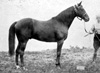
Tristan (GB) ch
c 1878 Hermit (GB) - Thrift (GB),
by Stockwell
(GB).
Sire Line Camel.
Family
10-d.
|
Hermit's most famous son was
probably Tristan, who was as tough as Hermit was delicate. Even in an
age of non-specialisation his versatility was exceptional; he possessed
remarkable stamina, sprinting speed and the ability to carry
back-breaking weights. Trained at Newmarket by Tom Jennings, he won
twenty-nine races over five seasons, including the Ascot Gold Cup, the
July Cup, Newmarket’s premier sprint, and was three times a winner in
consecutive seasons of the Grand Prix de Deauville, the Hardwicke Stakes
and the Champion Stakes, the latter in a dead-heat on two occasions,
with Thebais in 1878 and Lucerne in 1880. Following a period at stud in
France he was reimported by the Duchess of Montrose. He stood at the
Sefton Stud, where he got the Oaks winner,
Canterbury
Pilgrim, who was the dam of Chaucer and Swynford. Of Hermit’s other celebrated sons
and daughters, Shotover won the Two Thousand Guineas and Derby;
St. Blaise, the Derby; Thebais, the One Thousand Guineas and the Oaks;
Lonely, the Oaks; and Timothy, the Ascot Gold Cup.
Potentially his
greatest son was Friar's Balsam. He won seven top class races as a
two-year-old including the New Stakes at Ascot, the Richmond Stakes at Goodwood, and the July
Stakes, Dewhurst Stakes and Middle Park Plate at Newmarket. He defeated
Seabreeze, the Oaks and St Leger winner of the following season, three
times, and in the New Stakes, as one scribe put it:
"Ayrshire," who was to win the Derby the following year,
"hardly saw which way he went." He was three-to-one on for the
Two Thousand Guineas, and victory seemed a formality. Surprisingly, on
the way to post, an abscess burst in his lower jaw (why it went
unnoticed in the preliminaries is unrecorded). Consequently he ran
deplorably. He did win the Champion Stakes at the end of the season,
beating Minting, but he never reproduced the ability he had shown as a
two-year-old.
Although Hermit's daughters were
thought to cross very well with Isonomy, sadly, Hermit’s line has all
but died out. The most notable winner of recent times tracing to him in
direct male line was Precipice Wood, who won the Ascot Gold Cup in 1970.
Abergwiffy, probably the best son of Precipice Wood, left only a few
modest winners. Another of Hermit's descendants, Guersant, was sent to
Japan and was a leading sire there, although his line has all but
disappeared as well.
Curiously enough, the Hermit sire
line is alive and well in the Quarter Horse breed. Three Bars, winner of
a single stakes race, acheived enormous success as a sire. His
descendants dominated much of the cutting, halter and pleasure events,
and through his thoroughbred son, Rocket Bar, are still leading the
quarter horse racing sector. Dash for Cash and his son, First Down Dash,
the latter foaled in 1984, were both world champion runners and leading
sires.
Hermit was Champion Sire seven
times, from 1880 to 1886, inclusive, and was second to Hampton in 1887.
He was also Champion Broodmare Sire five times. He died in 1890, at the
age of twenty-six.
Thanks to Ann Ferland, Marc Huglin, Susan Larkin
and Eric Graham for their help.
© Anthony Byles |
|
|
|
|
|
|
|
|
|
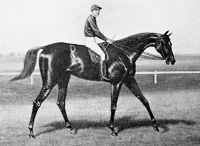
Alicante, by Hermit |
Alicante
(FR)
ch f 1887 (Hermit - Madeira, by Thunderbolt). Sire Line Camel.
Family 5.
Alicante was owned by Russian-born Monsieur Maurice Ephrussi, who also
owned the Prix du jockey Club winner Mordant (ch c 1904 War Dance). She
was the winner of the Cambridgeshire Stakes, the Prix de la Foret, the Prix Jean Prat
(twice) and the Prix Royal Oak. She was later the grandam of the Premio
Parioli winner Torcicollo (ch c 1918 Signorino). |
|
|
|
|
|
|
|
|
|
|
|
Bavarde (FR)
br f 1884
(Hermit - Basilique, by Durch Skater). Sire Line Camel.
Family 12-g. Winner
of the Prix de Diane, Prix la Rochette (twice) and Prix Royal Oak, dam
of Prix Royal Oak winner Bombon (ch c 1892 Richelieu), and ancestress of the
superb Argentine stallion Barranquero (ch c 1925 Verdun). |
|
|
|
|
|
|
|
|
|
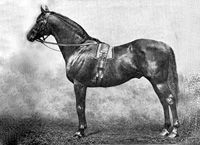
Friar's Balsam, by Hermit |
Friar's Balsam (GB)
ch c 1885 (Hermit -
Flower of Dorset, by Breadalbane). Sire Line Camel.
Family 2-k. Bred by Henry
Gerard Sturt (1825-1904), 1st Baron Alington, his dam was thought
undistinguished but his grandam, Imperatrice (b f 1859
Orlando), won the Park Hill
Stakes and her grandam, Martha Lynn (br f 1837 Mulatto), foaled Lord
Zetland's mighty Voltigeur (br c
1847 Voltaire). Friar's
Balsam was raced in a partnership with Sir Frederick John William
Johnstone (1841-1913), 8th bt, that was known as the "Old Firm" and who
had their horses at this time with John Porter at Kingsclere. A
brilliant two year old, he won all seven of his starts, including the
Dewhurst Plate, Middle Park Plate, July Stakes, New [Norfolk] Stakes,
Richmond Stakes and the Molecomb Stakes defeating the future Two
Thousand Guineas and Derby winner Ayrshire (br c 1885 Hampton) and the
future Oaks and St Leger winner Seabreeze (ch f 1885 Isonomy) along the
way. As a three year old he started the year by stepping on a rein and
wrenching his jaw severely enough to cause an abcess that went unnoticed
until his run in the Two Thousand Guineas. He finished fifth, behind
Ayrshire, whilst the abcess broke and was said to have nearly choked
him. He was withdrawn from the Derby but came back in September. He went
unplaced in his next start but recovered to win the Champion Stakes,
defeating the Grand Prix de Paris winner Minting (b c 1883 Lord Lyon) by
half a length. He was also among the field in his only start at four. He
retired to the Blankeney Stud where he covered for a fee of 100 guineas.
His notable offspring include the stallion Voter, who did well in
America, Mother Siegel, dam of King Edward VII's Two Thousand Guineas
and Derby winner Minoru (br c 1906 Cyllene) and Grand Marnier, grandam
of Lord Glanely's Derby winner Grand Parade (bl c 1916 Orby). Friar's
Balsam died in 1899. |
|
|
|
|
|
|
|
|
|
|
|
Gamin (FR)
ch c 1883 (Hermit - Grace, by Scottish Chief). Sire
Line Camel.
Family 12-a. Winner
of the Poule d'Essai des Poulains, Prix la Rochette (twice) and Prix
Royal Oak, he sired the Poule d'Essai des Poulains winner, Beaujolais
(ch c 1891), the Prix de Diane winner, Cambridge (ch f 1895), and the
Prix du Jockey Club winner, Gospodar (ch c 1891). |
|
|
|
|
|
|
|
|
|
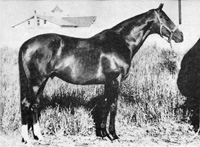
Guersant |
Guersant (FR)
b c 1949, by Bubbles (FR) - Montagnana (FR), by
Brantome (FR). Sire Line Camel.
Family 14-c. Bred by Baron
Édouard de Rothschild (1868-1949) at the Haras de Meautry he was a full
brother to Ocarina (ch c 1947) and half brother to Violoncelle (b c 1946
Cranach). His half sister Flute Enchantee (b f 1950 Cranch), herself a
winner of the Grand Prix de Deauville, became the dam of the winner and
leading sire Luthier (bbr c 1965 Klairon). In the colours of Baron Guy
de Rothschild (1909-2009) he ran for three years, winning eight of
fourteen, including his only start at two, the Prix Feb at
Maisons-Laffitte. As a three year old he won the Prix Djebel, the Poule
d'Essai des Poulains, Prix de la Port Maillot and Prix de la Foret,
finishing third in the Prix Greffulhe and fourth in the Prix Lupin, Prix
Jacques le Marois and Prix de Chantilly. As a four year old he won the
Prix Ganay, Coronation Stakes and Hardwicke Stakes, finishing second in
the Eclipse Stakes and fourth in the Prix Edmond Blanc. The Eclipse
Stakes at Sandown Park, won by Marcel Boussac's Argur (ch c 1949
Djebel), turned out to be his last effort as he pulled a muscle and was
retired. After syndication he went to Ireland and covered at the Fort
Union Stud in Adare. Among his offspring were J H Thorsby's Spithead (b
c 1956), champion two year old in Ireland, J McShain's Irish St Leger
winner Barclay (b c 1956) and Lord Ennisdale's Desmond Stakes winner
Light Horseman (b c 1956). In later years his daughters were useful;
Fighting Edie produced the Grand Prix de Saint-Cloud winner Felicio (br
c 1965 Shantung) and Thetis foaled the Sprint Cup winner Green God (ch c
1968 Red God). In 1962 the Chiba Shadai Bokuju brought Guersant to
Japan. He repaid their confidence in full, getting numerous classics
winners, such as Kikuka Shô (Japanese St Leger) winner Knit Eight (ch c
1964) and Yushun Himba (Japanese Oaks) winner Hiroyoshi (b f 1963). He
gained leading sire honours in 1969. His daughters proved valuable in
the stud as well, producing the likes of Yushun Himba winner Dyna Carle
(b f 1980 Northern Taste). Guersant made his own contribution to the
enormous succes that Shadai Farm enjoys today. He died in 1974. |
|
|
|
|
|
|
|
|
|
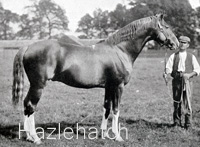
Hazlehatch, by Hermit |
Hazlehatch (GB)
ch c 1885 (Hermit - Hazledean, by Cathedral). Sire
Line Camel.
Family 11. Notable for the
confusion caused by the spelling of his name but he also got several good
daughters, including Eryholme (ch f 1898) 3rd dam of the stallions
Pharos (br c 1920 Phalaris) and Fairway (br c
1925 Phalaris); Hazlehen (b f 1892) 2nd dam
of the Nunthorpe Stakes winner and stallion Golden Boss (ch c 1920 The
Boss); and Hazlebeech (b f 1894) the dam of the Nagroda Prezesa Rady
Ministrow and Nagroda Iwna winner Darial (b c 1907 Darley Dale). |
|
|
|
|
|
|
|
|
|
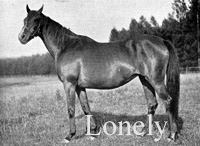
Lonely, by Hermit |
Lonely (GB)
b f 1882 (Hermit - Anonyma, by Stockwell).
Sire Line Camel.
Family 21-a. Winner
of Oaks Stakes, dam of the useful stallion Planudes (b c 1897
St. Simon), grandam
of the good stallion Maltster (br c 1897 Bill of Portland), and ancestress of In Reality
(b c 1964 Intentionally). |
|
|
|
|
|
|
|
|
|
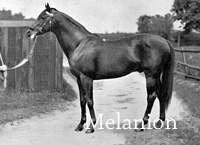
Melanion, by Hermit |
Melanion (GB)
b c 1886, by Hermit (GB) - Atalanta (GB), by
Galopin (GB). Sire Line Camel.
Family 8-h. A half brother to the
Derby and Two Thousand Guineas winner Ayrshire (bbr c 1885 Hampton) and
the St James's Palace Stakes winner Troon (b c 1892 Hampton) he was
later a useful stallion. |
|
|
|
|
|
|
|
|
|
|
|
Moorhen (GB)
bbl f 1873 (Hermit - Sister to Ryshworth, by
Skirmisher). Sire Line Camel.
Family 19-c. Dam
of the very good stallion Gallinule (ch c 1884 Isonomy), winner of the
National Produce Stakes. Gallinule numbered among his offspring six
Irish Derby winners, Carrigavalla (b c 1898), Gallinaria (ch f 1897), Gulsalberk (b
c 1893), Noble Howard (ch c 1895), Oppressor (br c
1896), and Portmarnock (br c 1892), the Two Thousand Guineas winner Slieve Gallion (bbl
c 1904), the St Leger winners Night Hawk (bbr c
1910) and Wildfowler (ch c 1895), the One Thousand Guineas, Oaks and
St Leger winner Pretty Polly (ch f
1901), the Irish Oaks winner Dabchick (bl f 1894), the Deutsches Derby
winner Chilperic (ch c 1908), the Preis der Diana winner Waldkatze
(ch f 1905) and the German St Leger winner Hammurabi (ch c 1903).
Moorhen also produced the St James's Palace Stakes winner Pioneer
(br c 1886 Galopin). |
|
|
|
|
|
|
|
|
|
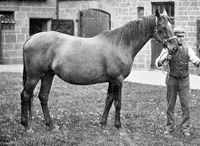
Shotover, by Hermit |
Shotover
(GB)
ch f 1879 (Hermit - Stray Shot, by Toxophilite). Sire Line Camel.
Family 13-c. Bred by Henry
Chaplin, she won the Derby Stakes, Two Thousand Guineas Stakes, Ascot
Derby and Park Hill Stakes. She is ancestress of
both Seattle Slew (bbr c 1974) and Mr Prospector (b c 1970). |
|
|
|
|
|
|
|
|
|
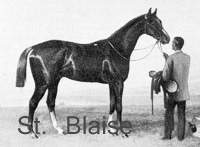
St Blaise, by Hermit |
St.
Blaise (GB)
ch c 1880 (Hermit - Fusee, by Marsyas). Sire Line Camel.
Family 22-b.
Bred by Henry Gerard Sturt, 1st Baron Alington, he won the Derby Stakes.
Brought to America in 1885 by August Belmont, he sired the Preakness
winner, Margrave (ch c 1893), and was a Leading Sire in 1890. He died
in a fire in 1909. |
|
|
|
|
|
|
|
|
|
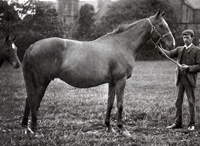
St Marguerite, by Hermit |
St.
Marguerite (GB)
ch f 1879 (Hermit - Devotion, by Stockwell).
Sire Line Camel. Family
4-n.
Bred by William Stirling Crawfurd, she won the One Thousand Guineas,
Chesterfield and Nassau Stakes. In the stud she produced the Oaks and
St Leger winner Seabreeze (ch f 1885 Isonomy), the stallion Tredennis
(ch c 1898 Kendal) and the dam of triple crown winner Rock
Sand (br c 1900 Sainfoin). |
|
|
|
|
|
|
|
|
|
|
|
Thebais (GB)
ch f 1878 (Hermit -
Devotion, by Stockwell). Sire Line Camel.
Family 4-l. Full sister to St.
Marguerite, she was the winner
of the One Thousand Guineas Stakes, Oaks Stakes, Criterion Stakes, Doncaster Cup, Gold Vase, Nassau Stakes and Yorkshire Oaks. |
|
|
|
|
|
|
|
|
|
|
