 |
| Boston (USA) |
|
| Boston (USA) |
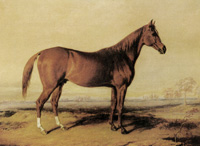 Above, by Edward Troye. Mackay-Smith reasons that it was painted from a charcoal drawing done by Troye at Oaklands in 1839. The other well known painting of Boston was done by Henri De Lattre, and subsequently engraved for the Turf Register.  Sire Line  King Herod Sire 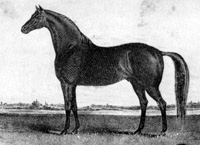 Timoleon |
Boston ch c 1833 (Timoleon - Sister to Tuckahoe, by Ball's Florizel). Sire Line King Herod. Family 40. Boston was bred in Richmond, Virginia by John Wickham, and supposedly named after a fashionable card game of the period. He was described as a chestnut with a white blaze which extended down over his muzzle giving rise to his nickname "Old Whitenose". His head was thought to be plain, and his shoulders were considered very fine. He had length and depth, with powerful loins, thighs and hocks. His knees and hocks were well let down and his pasterns were long and springy. He was noted for the soundness of his legs and feet. As a two-year old he was either sold or lost in a card game to Nathaniel Rives of Richmond for $800. Always an incorrigible colt, he was sent at three to John Belcher, assistant trainer to Colonel William Ransom Johnson, for breaking and early training. After an inauspicious start, including several remedial sessions to cure his roguish ways, he would become the greatest racehorse in 19th century America.
Sources vary in their reports of the numbers and accounts of his races, however, he probably ran about forty-five races, winning thirty of these at four-mile heats, and nine at three-mile heats, winning forty times in total. He was undefeated at four and five. At six he was purchased by James Long of Washington, D C. It was said that the only time he was fairly defeated was by the grand filly Fashion (ch f 1837) in the second of their famous North-South battles, in which Fashion set a new world record of 7:32 1/2 for a four-mile heat. William T Porter wrote of him: "This wonderful horse went on winning race after race at four-mile heats, beating almost every horse of any pretensions, from Georgia to New York, whether he met them single handed or in a crowd. If the course chanced to be knee deep in mud, so much the better for him; if it happened to be light and and well adapted for time, the circumstance was equally in his favor."
Boston raced until the age of ten although he had been in the stud the previous two years. He stood in Hanover County, Virginia, then in Washington, D C. In the winter of 1846 he was led over the mountains to stand his last seasons near Spring Station, Kentucky. He was said to have had limited access to the best mares until late in his stud career, and in his final season he sired his best sons, Lecomte (ch c 1850) and Lexington (b c 1850). Other notable offspring include Red Eye (b c 1846), Bostona (ch f 1846), Nina (b f 1848) dam of Planet (ch c 1855), and Madeline (ch f 1849) dam of Maggie B. B. (ch f 1867). He was a Leading Sire three times from 1851 to 1853 and stood second on the list in 1854. He was also a noted sire of trotters. Blind and ailing in his latter years, he died in January of 1850. |
|||||||||||||||||||||||
|
|
||||||||||||||||||||||||
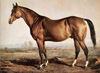 |
Lexington (USA) b c 1850 (Boston - Alice Carneal, by Sarpedon). Sire Line King Herod. Family 12-b. | |||||||||||||||||||||||
|
|
||||||||||||||||||||||||