|
| Sir Archy (USA) |
|
| Sir Archy (USA) |
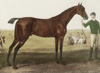
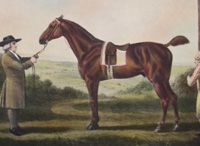
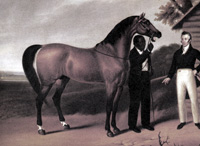
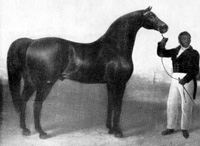 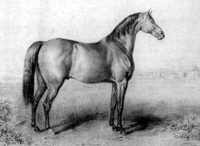 Above, painting by Alvan Fisher, commissioned by Charles Henry Hall of New York, based on Fisher's sketches of Sir Archy done at Mowfield in 1823. Contemporary horseman thought the likeness a good one. Harrison quotes a description by an eyewitness to his turf career, "His figure is correctly drawn by Fisher; he has even presented a correct likeness of the way in which he stood, from lameness in his left stife, from an accidental injury after he became the property of Mr. Amis." Fisher's painting was engraved for the Turf Register in 1829, and later for Frank Forester's book Horse of America.Fisher's painting was also used as the model for the most recent portrait of Sir Archy done by Martin Stainforth. Below, Mackay-Smith notes that Edward Troye never met Sir Archy in person, and probably made this charcoal drawing from Fisher's painting. 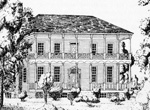 Mowfield, Northampton County, North Carolina, home of Sir Archy from 1818 to 1833.
Sire Line
Sire
|
Sir Archy b c 1805 (Diomed* - Castianira*, by Rockingham). Sire Line King Herod. Family 13. Sir Archy was bred by Colonel John Tayloe III of Mount Airy in Virginia in partnership with Captain Archibald Randolph of Ben Lomond, in Goochland County. His dam, Castianira, bred by Alexander Popham of Huntworth, Somerset, had been imported as a two-year old by Tayloe and had little success on the turf before entering the stud. Her ears were cropped, she was going blind, and tradition says she was less than handsome. However, when bred to the grand old Diomed, she produced the immortal Sir Archy. Sir Archy was probably born at Tree Hill, near Richmond, Virginia, where Diomed was standing. He was first named Robert Burns, which name was later changed by Tayloe to Sir Archie, in honor of his partner. Randolph sold his half-interest in the colt to Tayloe's nephew Ralph Wormeley VI of Rosegill, in Middlesex County, and Tayloe quickly followed suit, with Wormeley becoming the sole owner of Sir Archy.
Sir Archy wintered at Johnson's stables in Warrenton, North Carolina. With no trace of his previous year's illness his four-year old season started well. In his first start in the spring he beat Wrangler (b c 1805) in the Post Stakes at Fairfield, although Wrangler had won the previous day's Jockey Club Purse and was thought to be tired. The two colts met again two weeks later for the Jockey Club Purse at Petersburg, 4-mile heats, with Wrangler winning the first heat in impressive style. In the second heat Sir Archy finished so strongly that the judges took considerable time to award the heat, and the race, to Wrangler. Johnson challenged Wrangler's owner, Miles Selden, to rerun the heat, adding a hefty bet, but Selden declined. Johnson rested Sir Archy until the fall when the stable moved to Richmond. Sir Archy faced off against Wrangler again for the Jockey Club Purse there. There was some doubt that Sir Archy could survive the 4-mile heats given his weight gain over the summer, but in the first heat, although Wrangler led for two miles, Sir Archy flew by the field and distanced them all, gradually slowing to walk over the finish line and win the heat and the race. At Newmarket (Petersburg) the following week, Sir Archy distanced the field again to win the Jockey Club Purse in a single heat. His final race occurred at the Scotland Neck course in Halifax, North Carolina. General Carney's highly regarded colt Blank, was the only horse who would face him, but Sir Archy beat him by about a length in both heats. The time for the first heat at 7:52 was the fastest four miles seen thus far, south of the James River. The remarkable thing about Sir Archy's turf career, of seven starts and four wins, was the impression he made upon those who saw him. Johnson himself said "I have only to say, that in my opinion Sir Archie is the best horse I ever saw." No-one knows how fast Sir Archy could have run four miles; he was never extended. General William R Davie, among the spectators at Scotland Neck, was so impressed that he purchased Sir Archy for the then stratospheric sum of $5,000 and immediately retired him to the stud. He made his first season at the New Hope plantation, in Halifax County, owned by Davie's son Allen Jones Davie. Leased for the following year, 1811, by William Ransom Johnson, he stood at the Oaklands stud near Petersburg, Virginia, which belonged to Dr George Evans, Johnson's father-in-law. W E Broadnax stood him in 1812 and then he returned to New Hope until 1815. In 1816 he was leased to Edmund Irby who stood him at Nottoway, Virginia, returning in 1817 to Davie for that season. In 1818 he was sold to William Amis and stood at the Amis plantation Mowfield (sometimes spelled Moorfield) in Northampton County, North Carolina. When Amis died in 1823, his son John D Amis inherited Sir Archy, and he remained at Mowfield until his death in 1833.
One of the strengths often attributed to the offspring of Sir Archy, like those of his sire Diomed before him, was the ability to withstand intense inbreeding. Sir Archy was bred to his own daughters and to those of Diomed, and his offspring were bred to each other. The excellent racemare Old Flirtilla (b f 1820 by Sir Archy) bred Flirtilla (b f 1828 by Sir Archy), and the line continued to Lady Blessington (b f 1861) and well beyond. Henry (ch c 1819) who faced American Eclipse in epic battle was by Sir Archy from an unnamed daughter of Diomed. Sir Charles (ch c 1826 by Sir Archy) got Bonnets o' Blue (gr f 1827) from Reality (gr f 1813 by Sir Archy). Bonnets o' Blue produced the superlative racemare Fashion (ch f 1837) who defeated Boston (ch c 1833), a grandson of Sir Archy and the sire of Lexington (b c 1850). Virginian (b c 1815), perhaps not surprisingly, was bred in Virginia by W E Broadnax and was a full brother to Director (b c 1815). Owned by J J Harrison he won ten of fourteen races before retiring to the stud. He is probably best remembered for his daughter Mischief (b f 1826), the grandam of the leading sire Revenue (b c 1843 Trustee). Others among the legions of Sir Archy offspring deserving mention are Walk-in-the-Water (ch g 1813), also called Young Timoleon, who was said to have "won more races, run more miles and traveled farther than any other horse that ever lived"; Bertrand (b c 1820) who was probably Sir Archy's best son next to Sir Charles; Irby's Contention (ch c 1815) who won fifteen of twenty-three starts, ten of them in succession; Lady Lightfoot (br f 1812) the celebrated racemare and dam of the illustrious Bay Maria (b f 1831); Stockholder (b c 1819) who sired numberless winners, among them Betsey Malone (b f 1829) from whom descended Emperor of Norfolk (b c 1885) and Yo Tambien (ch f 1889); Sumpter (ch c 1818) who won eight consecutive races and sired Miss Obstinate (b f 1829) and Yarico (ch f 1831); and Timoleon (ch c 1814) who sired Boston. Sir Archy died in June of 1833 and was buried at either Mowfield or Ben Lomond; both places claim him as their own. Trevathan sums up his impact, "He got more distinguished racers than any horse in America, perhaps in the world, from all sorts of mares, with all kinds of pedigrees, and some with no pedigrees at all. It might be said with truth that he filled a hemisphere with his get." |
|||||||||||||||||||||||
 |
||||||||||||||||||||||||
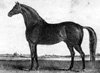 |
Timoleon (USA) ch c 1814 (Sir Archy - Mare, by Saltram). Sire Line King Herod. Family A24 . | |||||||||||||||||||||||
|
|
||||||||||||||||||||||||