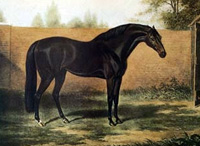
Godolphin Arabian

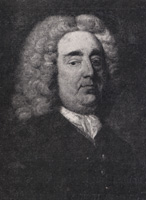
Lord Godolphin
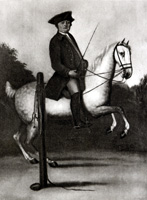
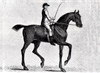
Apparently an accomplished horseman
this image illustrates
his expertise in
the manège.
Alphabetical
List of Godolphin Arabian Offspring
Chronological
List of Godolphin Arabian Offspring
|
Godolphin Arabian
br c 1724. Sire Line Godolphin
Arabian. The romantic story of
the discovery of the Godolphin Arabian pulling a cart in France was
based on a fictitious account written by Eugene Sue and published in La Presse in 1838. According to the Mr Prior, the Godolphin Arabian was
imported from France about 1730 by Mr Coke [Royal Studs:131].
Edward Coke, who had
attended Luneville Academy with Francis, the Duke of Lorraine, inherited
his stud at Longford Hall, in Derbyshire, in 1727. Coke's
brother-in-law, Sir Marmaduke Wyvill had acquired his Belgrade Turk from
the Duke of Lorraine. Mr Prior notes that Coke, who was also familiar with
Mr Curwen's imported French Barbs, could well afford any horse he
fancied, and "not one accustomed to the drudgery of drawing a
cart" [Royal Studs:132].
On Coke's death in
1733, his racehorses and broodmares were bequeathed to Lord Godolphin,
and his stallions to Mr Roger Williams [Royal Studs:133]. Later acquired by Lord
Godolphin, the Arabian entered stud near Newmarket.
Francis Godolphin (1678-1766), 2nd Earl
of Godolphin, Gogmagog, Cambridgeshire, was the second English owner of
the Godolphin Arabian. Francis married Henrietta Churchill (later Duchess of Marlborough), the
daughter of his father's good friend John Churchill (1650-1722), 1st
Duke of Marlborough.
Much controversy
exists over the breeding of the Godolphin Arabian and the General Stud Book notes, in 1827, that
his portrait suggests he was a Barb, although no mention of this
was made in 1791. As Mr Prior points out, the three people who knew the
horse best, his two owners, Mr Coke and Lord Godolphin, along with the
veterinary surgeon William Osmer, always called him an Arabian [Early
Records:132]. Lord Godolphin also owned the Brown Western Barb and a
Grey Barb, wherein some confusion may have taken root.
The General Stud Book
also says that "There is an original Portrait of this horse in Lord Cholmondeley's collection at Houghton; on comparing which with Mr
Stubbs's print of him, it will be seen that the disproportionately small
limbs, as represented in the latter, do not accord with the
painting." [GSB 1:392] It will be noticed that the Stubbs
versions are the only ones in which the horse is presented with the
unattractive, and to some, overly large, crest which was also the
subject of much criticism and controversy.
Standing 14 hands,
one and a half inches, without his shoes, he was a brown bay, with a
white off hind foot and with a little white on the inside corner of his
near hind foot [Royal Studs, 163].
William Osmer, who
had met the horse, said of him, "Whoever has seen him must remember
that his shoulders were deeper and lay farther into his back than any
horse yet seen; behind his shoulders there was but a small space; before
the muscles of his loin rose excessively high, broad, and expanded,
which were inserted into his quarters with greater strength and power
than any horse ever yet seen of his dimensions. It is not to be wondered
at that the excellence of this horse's shape was not in early times
manifest to some men, considering the plainness of his head and ears,
the position of his fore-legs, and his stunted growth, occasioned by
want of food in the country where he was bred." Since Mr. Osmer was
acquainted with the horse it is worth noting that he never referred to
him as a Barb.
Richard Berenger,
Gentleman of the Horse to King George III, described him as
plain-headed, with the roots of ears being wide apart and the ears
themselves having a noticeable outward droop. His crest was high, his
shoulders heavy and he was slightly over at the knees. His plain head
and large ears are well illustrated by Morier, though perhaps his lop
ears are best presented in the Marshall portrait. It would seem that his
descendant, Melbourne (br c 1834), twice a
Champion Sire, came by his lop ears honestly.
In a dissertation on
horses, published as part of the Supplement to the General Stud Book in
1800, Colonel Gilbert Ironside, who must have been thought an authority
on the subject, observes: "There was somewhat of wonderful virtue
and efficacy in the blood of a horse existing in England between forty
and fifty years ago, called the Godolphin Arabian although it not be
perfectly ascertained that he was of Arabian extraction, but from
whatever source it issued, it was his high-mettled blood which
communicated to the English horses that vigour and energy of spirits
which distinguishes their intrinsic goodness, and renders them, next to
the Arabs, far superior to any race. For the English, constantly
crossing their own with the breed of every other country, produce a
kind, though by no means as beautiful as the Arab, yet always surpassing
him in strength, and generally in swiftness. The Godolphin blood,
crossed with the offspring of the Barbs, are said to produce the best
English racers and hunters" [History of the Racing Calendar and
Stud-Book, 20].
He is eulogised on
the frame of the Morier portrait: "Esteem'd one of the best Foreign
Horses ever brought into England. Appearing so both from the Country he
came from & from the Performance of his Posterity. They being
Excellent both as Racers and Stallions & Hitting with most other
Pedigrees, and mending ye Imperfections of their shape. And is allowed
to have refresh'd the English Blood more than any Foreign Horse yet
imported." His overwhelming success as a sire is also noted in the
General Stud Book, which says: "It is remarkable that there is not
a superior horse now on the turf, without a cross of the Godolphin
Arabian, neither has there been for many years past" [GSB 1:392].
From the mare Roxana
he got Lath (b c 1732), thought to be the best racehorse since Flying
Childers. His son Regulus was broodmare
sire of Eclipse. However, his most important
contribution was his son Cade, full brother of
Lath, who sired Matchem, progenitor of the Matchem
sire line.
He was Champion Sire
in 1738, 1745 and 1747. In turn, he sired three Champion Sires, Blank
(b c 1740), Cade (b c 1724), and Regulus
(b c 1739). He also sired Matchless* (b c 1754) and
Selima*
(b f 1745). Whyte observed that "the great proportion of
both colts and fillies, produced by this celebrated horse
were of a bay colour like himself" [History of the British
Turf 1:88], and Robertson later stated that he "never sired
a chestnut, but had dun and grey offspring out of dun and
grey mares" [Lonsdale Library xxvii:86]. We found three
offspring supposed to be chestnut, however these could have
been errors in pedigree or record keeping. The Godolphin
Arabian appears to have been a pure breeding brown. He was in the stud
for about twenty years and died on Christmas Day in 1753, at Gogmagog in
Cambridgeshire. According to the General Stud Book, "he is buried
in a covered passage, leading to the stable, with a flat stone over him,
without any inscription." |
|
|
|
|
|
|
 |
 |
 |
| |
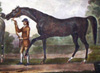
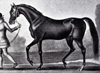
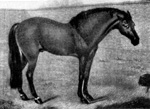
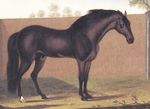
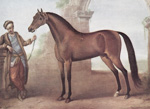
| (Left) This original
portrait, by David Morier, is the only one known to have been done from
life and is in the collection of the Marquis of Cholmondeley, Houghton
Hall, Norfolk. At the bottom of the portrait is written: "The
Original Picture taken at the Hills by D. Murrier. Painter to H:R:H. the
Duke of Cumberland". |
| |
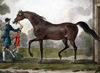
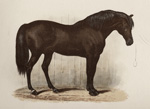
| (Center) The Faber Print, 1753,
after Morier, a copy of which made its way to Tulip Hill, Westriver, Maryland, the home of Samuel Galloway.
Mr Galloway's interest in the Godolphin Arabian would stem from his
purchase of a two year old colt from the fabled Selima* (b f 1745
Godolphin Arabian) at the dispersal sale of her importer, Benjamin
Tasker, in 1761. Galloway's Selim (b c 1759 Othello*) was a
distinguished racehorse in colonial America and later covered at Tulip
Hill and in Virginia. |
| |
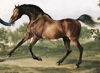
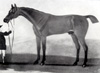
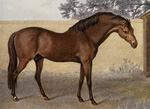
| (Right) After a portrait by
Ben Marshall, who was said to have had some sketches of the Godolphin
Arabian that had been done from life. Marshall is credited with a "Portrait of an Arabian, 1796" [British Sporting Artists:176]. |
| |
 |
 |
 |
| |
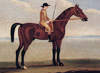
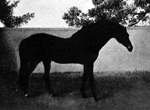
| (Left) The George Stubbs
portrait, an original painting in the William Woodward Collection, is
thought to have been copied from the Morier. The General Stud Book
says that "There is an original Portrait of this horse in Lord Cholmondeley's
collection at Houghton; on comparing which with Mr Stubbs's print of
him, it will be seen that the disproportionately small limbs, as
represented in the latter, do not accord with the painting." [GSB 1:392]
It may be remarked that the Stubbs
versions are the only ones in which the horse is presented with the
unattractive, and to some, overly large, crest which was also the
subject of much criticism and controversy. |
| |
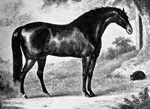
| (Center) The George Stubbs
portrait, an original painting, formerly at Studley Royal, Yorkshire, in
the Robert L Gerry collection. |
| |
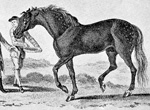
| (Right) The Butler print of the Morier portrait. |
| |
 |
 |
 |
| |
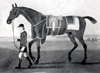
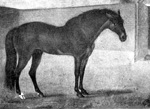
| (Left) The Henry Roberts
portrait, reproduced in the Sportsman's Pocket Companion, 1750c, after a drawing by James Roberts.
It may not be unreasonable to think that this image was
taken during the lifetime of the horse. This portrait was chosen by Theodore
Andrea Cook to illustrate his book A History of the English Turf
and is said to be from the engraving by Roberts at Cumberland Lodge. |
| |
| (Center) The J N Sartorius
portrait in the collection of Lord Rosebery at The Durdans. |
| |
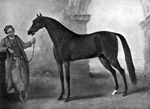
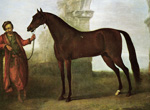
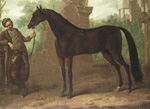
| (Right) The Gogmagog
"Library" portrait, by John Wootton, dated 1731, erroneously said by
Lady Wentworth to be in the collection
of Ernest E Hutton. It is not clear if this portrait has been positively
identified as the Godolphin Arabian, and in any case he was not acquired
by Lord Godolphin until after the death of Edward Coke in 1733. Early references to the portrait in the library at Gog Magog indicate the presence of a cat,
and in this portrait he is noticeably a bay, rather than the brown he
appears in other portraits. One would assume that both owner and artist
would have been well aware of colour. |
| |
 |
 |
 |
| |
| (Left) Image courtesy of The Cox Library. Ernest Edmund Hutton, (1876-1972), born at Cudham,
Kent, established a collection of early ancestors of the
thoroughbred racehorse. He died at Bridge House, Eye,
Suffolk. The Hutton portrait was published in 'The Horse'
(Christmas 1929 issue in an article by Hutton entitled 'The
Godolphin Arabian and his sons' p62-67). On a technical
point perhaps this painting should be called the Coke
Arabian, rather than the Godolphin Arabian, since the horse
was not yet in the Godolphin stud when the portrait was
taken, said to be in 1731. |
| |
| (Center) John Wootton (1682c-1764) was one of the kingdom's most
popular horse painters. Among his patrons were King George
II, Frederick, Prince of Wales, the Duke of Bedford, the
Duke of Marlborough and the Duke of Richmond. It was an
accepted practice in those days to make copies of popular
paintings for those wishing to have them. |
| |
| (Right) This Wootton portrait of the Godolphin Arabian appears to
have a more detailed background. None of the Wootton
portraits seem to correspond to the physical descriptions given by
persons who saw the Godolphin Arabian while he was alive.
Since several of these paintings were said to have been painted in 1731,
before the Coke Arabian entered the Godolphin stud,
perhaps they were instead a portrait of Lord Godolphin's Whitefoot (b
c 1719 Bay Bolton). Whitefoot was used extensively in the Godolphin stud and has over
forty known offspring. |
|