|
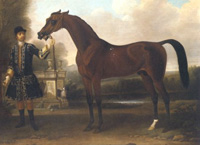
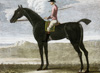
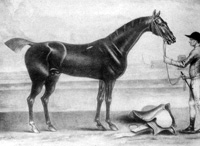
Bay Bolton

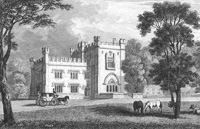
Bolton Hall
Sire Line

Darcy's White Turk
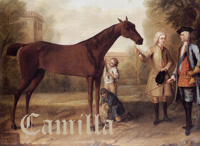
Camilla, by Bay Bolton
Courtesy of
Country Life
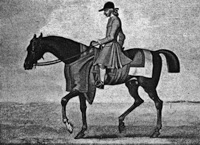
Whitefoot, by Bay Bolton
|
Bay
Bolton br c 1705 (Grey Hautboy - Mare by Makeless).
Sire Line Darcy's
White Turk. Family
37. Bred in Yorkshire by
Sir Mathew Pearson (1651-1712) at Lowthorpe, near Bridlington,
he was first named Brown Lusty. He was later sold to
Charles Paulet (1661-1722), 2nd
Duke of Bolton, who called him Bay Bolton. Pick describes
him as "eminent both for his figure and running, and
likewise as an excellent stallion". His stud
career was a great success. He sired the Champion Sire Bolton
Starling (gr c 1727). His son Fearnought
was considered to be one of the best runners at Newmarket
in his day. His daughter Gipsey (f 1725) became the second
dam of Old Snap (br c 1750),
a Champion Sire four times. His most important offspring
was probably Bonny Lass (b f 1723), the taproot mare of
Family 1-a. His influence
was also felt in America. Through Bolton Starling he founded
a sire line that would culminate with the American-bred
Bay Yankee (b c 1798). His son Bolton Looby (br c 1723)
sired Tryal* (ch c 1742), whose daughters became the foundation
matriarchs of American Families A13 and A18; and Bolton
Sloven (br c 1718) sired Beau* (ch c 1731), a horse much
liked by colonial American breeders.
During his stud career Bay
Bolton was a Champion Sire seven times between
1724 and 1734. He died at Bolton Hall, Bedale, Yorkshire,
in 1736. He is said to have been buried "with his shoes
on at the top of the avenue opposite the Hall, at Bolton,
between the large stone pillars, on Middleham High Moor".
|
Bay Bolton |
Grey Hautboy |
Hautboy |
Darcy's White
Turk |
|
Royal Mare |
|
|
|
|
|
|
Makeless Mare |
Makeless |
Oglethorpe
Arabian |
|
|
|
Brimmer Mare |
Brimmer |
| Diamond Mare |
|
|
Race
Record |
At five,
racing for Sir Matthew Pierson he won Queen Anne's Gold Cup at
York in his first start. The Turf Register makes note of his
extraordinary victory over eight six-year
olds, given the quality of the field
[Pick 1:4].
He followed that with a victory in the Great Subscription Purse at Middleham Moor and
a prize at Quainton Meadow.
Running
for the Duke of Bolton at Newmarket, Bay Bolton won a match
against Old Wyndham (gr
c
Hautboy), owned by the Duke of Somerset.
In his next match he defeated Sir
M Pierson's Merlin. He is also said to have won two matches against
Tregonwell Frampton's Dragon. |
|
|
|
Camilla (GB) |
|
|
|
ch f 1722 (Bay Bolton - Old Lady, by
Pulleine's Chesnut Arabian). Sire Line Darcy's
White Turk. Family 24. Bred
by Charles Powlett (1685-1754), the 3rd Duke
of Bolton, Camilla attained considerable
distinction on the turf. She ran for four
years at Newmarket. In 1729 she defeated
Lord Halifax's Favourite in a match for 200
guineas, collected a forfeit from the Duke
of Devonshire's black colt and lost a 300
guineas match to Lord Milsintown's Bald
Charlotte. In 1727 she collected a forfeit
from Captain Collyer's Yellow Richmond and
defeated Mr Collyer's Peggy-Grieves-Me in a
match for 500 guineas. In 1728 she lost a
300 guineas match to Mr Panton's Osmyn, but
later the same month redeemed herself and
beat Osmyn for a 300 guineas match. She also
won a 200 guineas match against Lord Essex's
Smiling Ball. In 1729 she defeated the Duke
of Somerset's (Pretty) Peggy to record a
victory in a match worth 300 guineas. She is
the ancestress of most of
Family 24. |
|
|
|
Brother
to Fearnought (GB) |
| |
| c 1726c
(Bay Bolton - Mare, by Lexington Arabian). Sire Line Darcy's
White Turk. Family 1. Bred by
the 3rd Duke of Bolton, he was sometimes called Herbert's Horse
[GSB 1:116]. He
sired the unnamed Fearnought Mare (gr f) who became the dam of Beaufremont
(b c 1758 Tartar) and Hutton's Cade
Mare, the ancestress of most of Family
25. |
|
|
|
Whitefoot (GB) |
|
|
br c 1719 (Bay Bolton - Mare, by
Darley's
Arabian). Sire Line Darcy's
White Turk. Family 1. Bred by
Sir William Ramsden (1672-1736), 2nd bt, he
was a full brother to the legendary Bonny
Lass. Purchased by Lord Godolphin he ran for
five years, exclusively in matches at
Newmarket, and won all of them. Over the
course of his career he defeated Captain
Colyear's Bay Wilkinson (b c 1717
Snake)
(twice), Mr Honywood's Young True Blue (gr c
1718 Honywood's Arabian), Mr Panton's Osmyn
(bl c 1721 Greyhound) and the Duke of
Somerset's Cinnamon (ch c 1722
Wyndham),
winning a total of over 1000 guineas. He
also collected forfeit twice. In the
Godolphin Stud he was used extensively prior
to the arrival of the
Godolphin Arabian.
Among his offspring were (1) Sister to Bandy
(b f 1731), ancestress of the Duke of
Bedford's Oaks winner Hippolyta (ch f 1787
Mercury) and Lord Rockingham's Doncaster Cup
winner Phocion (b c 1770
Sampson), (2)
Hackney's Dam, the 2nd dam of Lord
Rockingham's Doncaster Cup winner Tantrum (b
c 1760 Cripple), (3) Whitefoot Mare (b f
1737), dam of Jenny Dismal (b f 1752c
Dismal) who founded a small but influential
family in the Baylor stud in Virginia, (4)
Lord Leigh's
Diana (br f 1740) ancestress of
Lord Grosvenor's Oaks winner Bellina (ch f
1796 Rockingham) and Mr Wilson's July Cup
winner Pantaloon (b c 1803
Buzzard), and (5)
Lord Leigh's
Charming Molly (br f 1742),
ancestress of Lord Grosvenor's Derby winner
John Bull (ch c 1789 Fortitude). When he was
around the age of twenty Whitefoot was sold
to John Hodgson of Longcoom, near Woodstock,
Oxfordshire, where he covered for a fee of
two guineas.
(Whitefoot has
been restored here as the sire of Lord
Leigh’s Diana and Charming Molly. The
General Stud Book, purporting to correct an
error in Cheny’s calendars, changed their
sire to Second based on “a certificate under
the hand of the Breeder”. A letter to Lord
Rockingham from this breeder, Gabriel
Hanger, reveals that Mr. Hanger had bred six
fillies from his Stanyan Arabian Mare
(WWM/R/193/21). Two of them were indeed by
Second, indicating that Mr. Weatherby had
seen an authentic certificate, but neither
of these fillies was Lord Leigh’s. The
particular fillies sold to Lord Leigh were
daughters of Whitefoot, just as Cheny had
originally reported). |
|
|
|
Sloven (GB) |
| |
| br c 1719 (Bay Bolton - Sister 2 to Mixbury, by
Curwen's Bay Barb). Sire
Line Darcy's
White Turk. Family
9.
He was bred in Yorkshire by Charles Paulet, 2nd Duke of
Bolton. According to the General Stud Book "Partner
and Sloven were the same age, and Partner twice beat Sloven
when they were matched" [GSB 1:8]. However, according
to the Turf Register Partner (1718) beat Sloven
"allowing him 10l for the year" [Pick 1:14].
Baily's Racing
Register notes that Sloven first ran as a five year
old in 1724. In
May of 1724 he lost a match at Newmarket to Croft's
Partner (ch c 1718 Jigg)
and in May of 1726 he lost another match to Partner. In
April of 1729 he won a 500 guineas match at Newmarket against
Mr Panton's Thunderbolt over four miles. He also won the
Annual Prize at Farndon and 20 guineas at Oswestry. In the
stud he got Young Coquette, who contributed to Family
44, along with the good stallion Beau* (ch c 1731). |
|
| ch c 1731 (Bolton Sloven - Old
Coquette, by Basto). Sire
Line Darcy's
White Turk. Family
44. According to the American Stud Book
the imported horse called Beau was a grey colt by
Cartouch who ran in Ireland in 1754 [AmSB 1:6]. This
was based on Edgar's pedigree for for Lord
Portmore's Beau (gr c 1744 Old Cartouch) who ran and
apparently later died in Ireland. However, the
imported Beau appears to have had offspring in
America prior to 1754. Fairfax Harrison speculates
that he belonged to both Lord Halifax and the Duke
of Bolton in England and Secretary John Carter
(1696-1742) in Virginia, although this seems to be a
confusion based on a racing calendar
which states that the "Duke
of Bolton's Ches Colt, got by Sloven, 'gainst
Earl of Hallifax's Bay Colt, out of a Daughter of
Young Childers and Partner" [Cheny:1735]. As
far as can be ascertained the Duke of Bolton's Beau
collected a forfeit from Lord Halifax's bay colt at
Newmarket in 1736, paid a forfeit to Mr Panton's
Cato, and won a King's Plate at Canterbury in 1737.
He was advertised to cover in Ireland in 1740 and
1741 at Mr Samuel Gerrard's at Gibstown, near Navan
in County Meath for 1 guinea. He was said to have
been bred by the Duke of Bolton and his pedigree was
given as "by Sloven and out of the Coquete Mare
[Dublin Journal, 1740 & 1741]. We speculate that the
Coquete Mare was the Duke of Bolton's Old Coquette
by Basto and that if this is the Beau in question he
would have been exported to Virginia following his
tenure in Ireland, perhaps after the 1741 season. In
America, and sometimes called "Bow,"
he
sired the 3rd and 4th dams of Brandon, dam of
Meade's Celer (c 1776 Janus) and Clodius (b c 1778
Janus). The
"double bow" cross was highly regarded at the time. |